
Why We Focus on One-Page CVs (And When They Work Best)
Most recruiters spend only a few seconds scanning your CV. Does your second page even matter? Here is why we focus on one-page CVs and how it helps you stand out.

Why clarity beats length when applying for professional roles
Introduction
One of the most common questions job seekers ask is: how long should a CV be?
Some advice says one page. Other advice says two pages are fine. You’ll even see arguments that longer CVs are better for senior roles. The result is a lot of confusion, and many CVs end up either overcrowded or unfocused.
At CraftAI CV, we intentionally focus on one-page CVs. Not because longer CVs are always wrong, but because clarity, relevance, and readability matter more than including everything you have ever done.
A one-page CV forces you to prioritise what is most important for the role you are applying for. It encourages tailoring, removes unnecessary detail, and makes it easier for recruiters to quickly understand why you are a strong match.
How Recruiters Actually Read CVs
Here is the hard truth: Most recruiters don’t read CVs from top to bottom. At least, not at first. Instead, they scan.
In an initial review, a recruiter is usually trying to establish a few things very quickly, such as what role the candidate is targeting and whether their recent experience appears relevant. This first scan often lasts only a few seconds, and attention is directed toward clear signals rather than detailed narratives.
In many hiring processes, recruiters focus on a small set of basic details to decide whether a CV is worth a deeper look. During this early scan, attention commonly goes to:
- Location, particularly the candidate’s country of residence if relocation, visa eligibility, or remote work constraints apply.
- Current experience, including the candidate’s current role, company, and how long they have been in that position.
- Previous experience, in some cases looking briefly at the prior role to understand progression or relevance.
- Education, especially for roles that require a specific qualification or where education is a strong signal, such as healthcare, engineering, or other technical fields.
Depending on the role, recruiters may also quickly check for additional signals, such as:
- a relevant technical stack for technical positions
- certifications where these are required or preferred
The importance of each of these details can vary based on the role, seniority, and the number of applicants. However, they consistently form the basis of early screening decisions.
CVs that are dense, poorly structured, or spread across multiple pages can make these signals harder to spot. Important information may be missed simply because it takes too long to find.
A one-page CV helps reduce this friction. It presents the most relevant information in a compact, predictable format and makes it easier to identify alignment early. This does not mean recruiters refuse to read more detail, but it does mean your CV needs to earn deeper attention first.
The purpose of a CV isn't to document your entire career history. Its job is to clearly demonstrate relevance and move you to the next stage of the hiring process.
Why One Page Forces Better CVs
Think about it. A one-page CV works not because it is shorter, but because it forces you to make better decisions. When you run out of space, you have to prioritise what actually matters.
This prioritisation improves clarity. Recruiters can see your strongest signals quickly without having to filter through unnecessary detail. Job titles, skills, and key achievements are easier to spot, which makes it simpler to understand how your background fits the role.
One page also protects readability. Trying to fit too much information into a CV often leads to smaller fonts, tighter spacing, and crowded layouts. These changes may technically allow more content to fit, but they make the CV harder to scan and less pleasant to read. In practice, this works against you.
A well-structured one-page CV keeps spacing consistent, text readable, and sections clearly separated. It presents a focused snapshot of your experience rather than an exhaustive record. That focus makes your CV easier to engage with and more effective during early screening.
The constraint of one page isn't a limitation. It is a design choice that encourages relevance, clarity, and stronger communication.
One-Page CVs Only Work When the CV Is Tailored
A one-page CV is only effective when it is tailored to the role you are applying for. Without tailoring, a single page can quickly become crowded or vague as it tries to cover too many different roles at once.
The problem is that generic CVs are designed to be reused, not to get you hired. They often rely on broad descriptions, long skill lists, and responsibilities that are only loosely related to the job. When this kind of CV is forced into a one-page format, important details are either squeezed into unreadable layouts or reduced to generic statements that fail to show real relevance.
Tailored CVs work differently. By focusing on a specific role, you can remove experience and skills that are not directly relevant and give more space to the parts that matter most. This makes it possible to communicate your value clearly without increasing length.
Tailoring also helps you choose what to emphasise. For one role, a particular project or responsibility may be central. For another, it may be unnecessary. A one-page format works because it encourages these decisions instead of trying to accommodate everything.
In practice, one-page CVs fail when people attempt to use the same version for every application. When the CV is tailored, one page is often enough to clearly demonstrate fit and earn further attention.
Who One-Page CVs Are Best Suited For
One-page CVs are best suited to roles and candidates where relevance matters more than volume. In many modern hiring processes, recruiters are looking for a clear match rather than a complete career history.
They tend to work particularly well for:
- Graduates and early-career professionals, where recent education, placements, and internships are more important than listing every detail.
- Career switchers, who need to emphasise transferable skills and relevant experience rather than unrelated past roles.
- Professionals applying to clearly defined roles, such as roles in technology, marketing, operations, finance, product, or customer-facing positions.
- Applicants applying through online portals or ATS systems, where clarity and structure are essential for screening.
- Candidates applying to multiple roles, where tailoring a focused one-page CV is more practical than maintaining longer versions.
One-page CVs are not about minimising experience. They are about selecting what best supports the role you are applying for. Even candidates with several years of experience can often present their most relevant work clearly on a single page when the CV is tailored properly.
The key factor is not seniority, but relevance. If your experience can be prioritised and presented clearly for a specific role, a one-page CV is often sufficient.
When a One-Page CV May Not Be Enough
While one-page CVs work well in many professional hiring contexts, they are not the right choice for every situation. There are cases where additional detail is expected or genuinely useful.
A longer CV may be more appropriate for:
- Academic, research, or medical roles, where publications, teaching experience, or clinical history need to be documented in detail.
- Highly specialised or regulated professions, where certifications, licences, or formal requirements must be clearly listed.
- Senior or executive roles, where a longer career history and broader scope of responsibility may be relevant to the hiring decision.
- Applications that explicitly request a multi-page CV, particularly in certain public sector or international hiring processes.
Even in these cases, clarity still matters. Additional pages should add value, not repetition. A longer CV should be structured just as carefully as a one-page version, with clear sections and prioritised content.
At CraftAI CV, we focus on one-page CVs because they suit the majority of professional, role-focused applications today. For roles that require more extensive documentation, a different format may be more appropriate. The key is choosing a CV length that supports the hiring process rather than working against it.
Why CraftAI CV Is Built Around One Page
CraftAI CV is built around one-page CVs by design, not by accident. The decision reflects how CVs are typically reviewed and the trade-offs that come with longer documents.
One of the most common problems with longer CVs is that they encourage accumulation. Over time, roles, responsibilities, skills, and projects get added, but very little gets removed. The result is a CV that is technically complete, but difficult to scan and harder to tailor effectively.
By focusing on one page, CraftAI CV encourages prioritisation. Users are prompted to think about which experience supports the role they are applying for, and which details can be reduced or removed. This leads to CVs that are clearer, more focused, and easier to adjust for different applications.
From a design perspective, one page also protects readability. Font sizes, spacing, and section hierarchy can remain consistent without needing to compress the layout to fit more content. This helps ensure that CVs remain professional, readable, and suitable for both ATS screening and human review.
The goal isn't to limit candidates, but to help them present their experience in a way that reflects how hiring decisions are made. A one-page structure provides a practical framework for doing that well.
Common Myths About One-Page CVs
There are several persistent myths around one-page CVs that often discourage people from considering them, even when they would be a good fit. Most of these misconceptions come from outdated advice or misunderstandings about how CVs are used today.
“One-page CVs are only for graduates”
This is one of the most common beliefs, but it is rarely true in practice. One page isn't about how long you have been working, but about how much of your experience is relevant to the role. Many mid-level professionals can clearly present their most relevant work on a single page when the CV is properly tailored.
“More experience means more pages”
Let’s be honest: Just because you have 15 years of experience doesn't mean you need to show 15 years of details. Recruiters are almost exclusively interested in what you have done recently. Older or less relevant experience can often be summarised or reduced without losing important context.
“Recruiters expect long CVs”
In most professional hiring processes, recruiters don't expect length. They expect clarity. A concise CV that highlights the right experience is generally more effective than a longer one that requires additional effort to interpret.
“A one-page CV leaves out important details”
A one-page CV doesn't remove important information, it prioritises it. When space is limited, you are encouraged to focus on what supports your application rather than including information that does not directly contribute to your fit for the role.
“One-page CVs look too simple”
Simplicity is often a strength. Clean structure and clear hierarchy make CVs easier to scan and understand. A CV does not need to be visually complex to appear professional.
Most of these myths persist because CV advice is often shared without context. The effectiveness of a one-page CV depends on the role, the industry, and how well the content is tailored, not on rigid rules about length.
How to Build a Strong One-Page CV
A strong one-page CV is built through selection, not compression. The goal is to decide what earns space rather than trying to fit everything in.
Start with the role, not your history
Before editing your CV, review the job description and identify the skills and experience the role emphasises. Your CV should be shaped around those requirements, not around a fixed list of everything you have done.
This mindset shift makes it easier to remove content that does not directly support the application.
Prioritise recent and relevant experience
Give the most space to your most recent role and to experience that closely matches the job you are applying for. Older or less relevant roles can usually be summarised with fewer bullet points or reduced to job title, company, and dates.
This keeps the focus on what the recruiter is most likely to care about.
Limit bullet points and focus on outcomes
Bullet points should communicate value quickly. Aim for two to four bullets per role and focus on what you achieved or contributed, not just what you were responsible for.
If you don't know exact metrics, describe scope, responsibility, or technical impact rather than guessing numbers.
Keep skills concise and role-aligned
A long skills list rarely adds value. Instead, include a focused set of skills that are relevant to the role and supported by your experience. This improves readability and helps both recruiters and ATS systems identify your fit.
Use a clean, consistent layout
One-page CVs rely on clear structure. Use standard section headings, consistent spacing, and readable font sizes. Avoid shrinking text or margins to fit more content, as this usually reduces clarity.
Treat one page as a design constraint
If your CV does not fit on one page, it is often a sign that content needs to be prioritised rather than squeezed. Treat the page limit as a guide that helps you decide what is essential for this role.
A well-built one-page CV presents a clear snapshot of your experience and makes it easy for a recruiter to understand your relevance quickly.
Templates That Support One-Page CVs
A one-page CV is much easier to build when the template supports clarity and structure. The right template does not try to solve space constraints with visual tricks. Instead, it makes good use of hierarchy, spacing, and predictable sections.
Templates that work well for one-page CVs typically share a few characteristics:
- clear section headings that guide scanning
- consistent spacing that keeps content readable
- a logical flow from summary to experience to skills
- limited use of decorative elements that distract from content
These qualities make it easier to prioritise information without shrinking text or overcrowding the layout.
Templates that rely heavily on graphics, icons, or complex column structures can make one-page CVs harder to adjust. They often reduce flexibility and can cause important content to be hidden or misaligned when tailoring for different roles.
At CraftAI CV, our templates are designed with one-page constraints in mind. They are structured to highlight recent experience, keep skills concise, and maintain readability even when content changes between applications.
You can explore templates that support this approach in our library, including professional layouts designed specifically for role-focused, one-page CVs:
Choosing a template that complements your content makes it easier to keep your CV clear, tailored, and effective without fighting the layout.
Final Thoughts
A one-page CV isn't about following a strict rule. It is about making deliberate choices that help a recruiter quickly understand why you are a good fit for a specific role.
When a CV is tailored, focused, and clearly structured, one page is often enough to communicate the most important information without distraction. It encourages relevance over repetition and clarity over completeness.
Longer CVs still have their place in certain contexts, but for many professional applications, especially those reviewed quickly or screened through ATS systems, a concise and well-prioritised CV is more effective.
If you want to turn your experience into a clear, role-focused one-page CV without spending hours rewriting it for each application, CraftAI CV can help structure and tailor your CV automatically.
You can start tailoring your CV here: tailor

Related articles
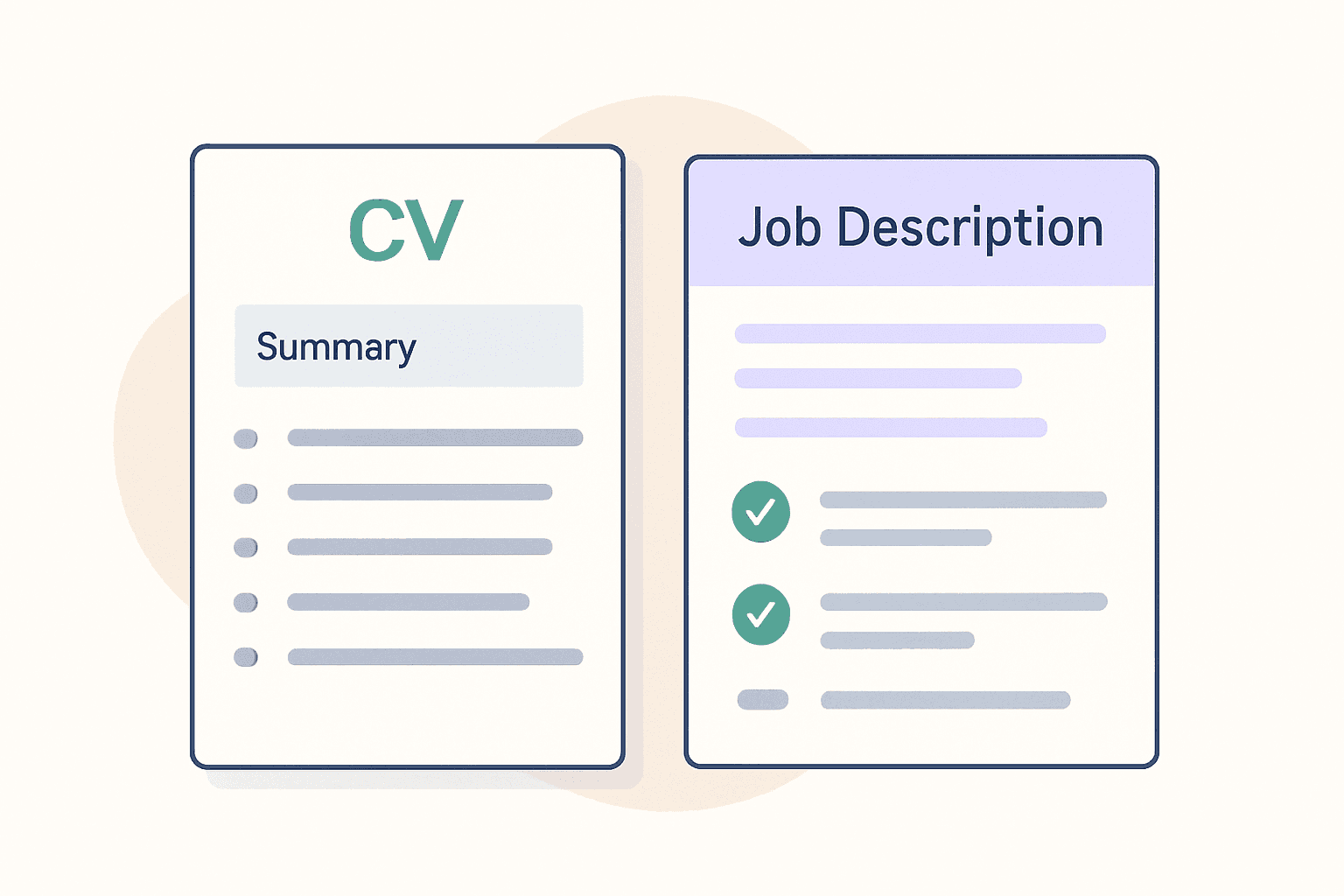
How to Tailor Your CV to Any Job (Step-by-Step, With Examples)
Stop sending generic CVs that get ignored. This guide shows how to match your CV to the job description so recruiters can quickly see why you’re a strong fit.

Why Your CV Isn’t Getting Interviews (And How to Fix It)
Not getting interviews? Learn how recruiters scan CVs, how ATS affects screening, and the quick fixes that improve response rates.